

People often assume that software vulnerabilities are solely a result of defects within the software code. However, poor configuration and implementation of software is often exploited. The growing complexity of software and rapid change or product lifecycle combined with operational and budget pressures can result in the poor compliance to security baselines.
Some examples of security risk due to poor adherence to security best practice include:
Sensitive information on the server read by unauthorized individuals or changed in an unauthorized manner due to poor Identity and Access Management (IAM).
Sensitive information is transmitted in an unencrypted format which increases the risk of interception between the server and the client.
Denial of Service (DoS) attacks that are directed at the server or its supporting infrastructure, denying or hindering users from using its services.
Malicious entities can exploit weak configurations or non-critical services in the application to gain unauthorized access.

To mitigate common security threats requires a multi-layered approach to security that focuses on people. Good security practice must be a mandatory component of system and application commissioning plans and must include the adoption of a continuous monitoring process.
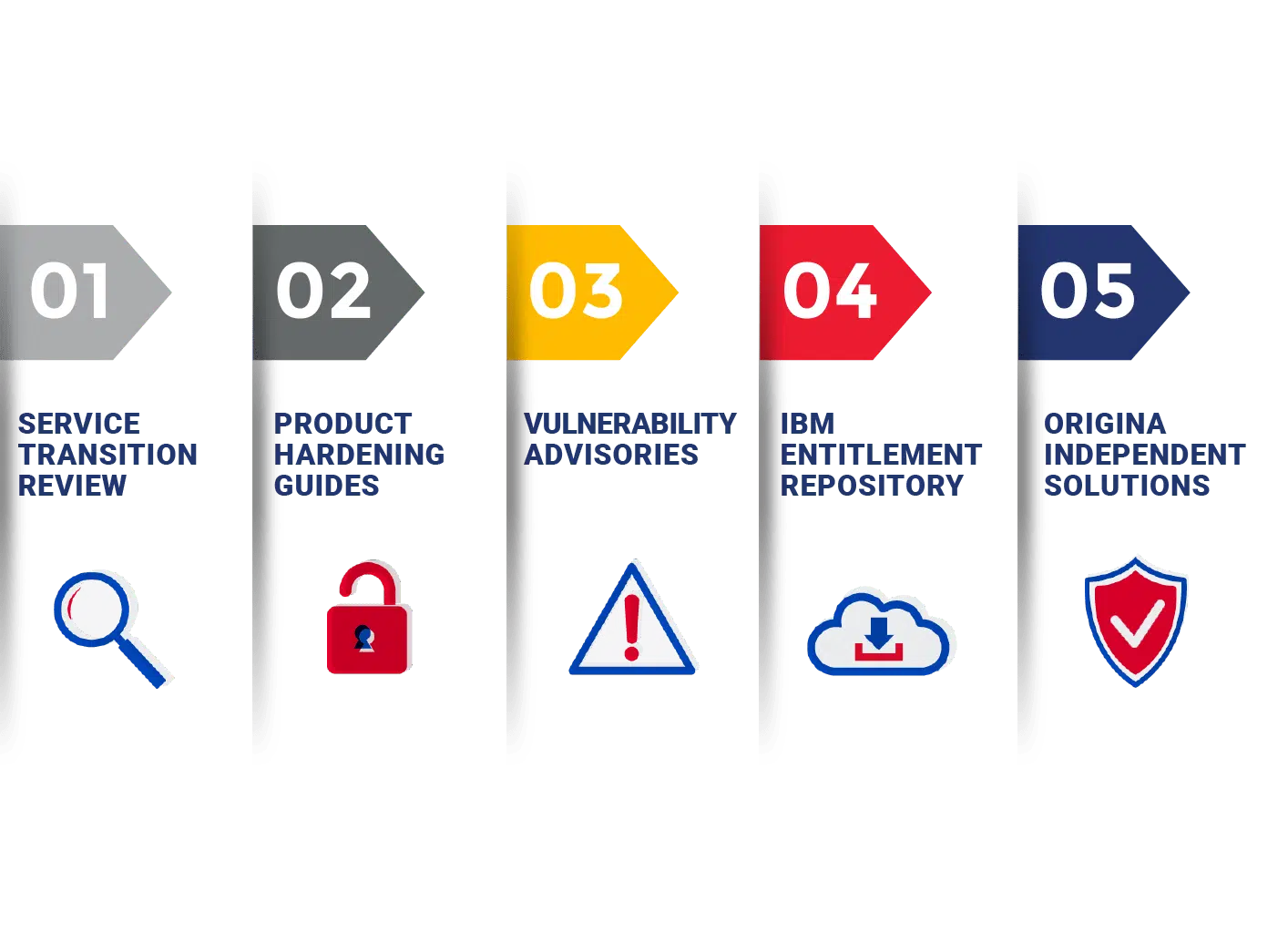
Origina’s hardening guides are a collaboration between our Global Independent Experts and our security team. The hardening guides have a single purpose: to strengthen the security posture of your software products and reduce the risk of impacts to the confidentiality, integrity, or availability (CIA) of applications and the data they process or host.

Origina uses a risk-based, multi-layered approach to help you proactively protect your software investments against cybersecurity threats. We focus on identifying exposures (vulnerabilities and misconfigurations) and guiding appropriate mitigating actions to reduce the risk of impacts to the confidentiality, integrity, or availability (CIA) of your systems.
Origina’s hardening guides are a key pillar of this approach. Hardening goes beyond default security settings: it addresses attack risk by recommending actions such as disabling unnecessary services, removing unneeded software, closing open network ports, and reviewing and tightening configuration settings.
Risk-based assessment during onboarding to inventory assets, surface operational risks, and deliver clear, prioritized remediation recommendations.
Product-specific hardening guidance that reduces risk by closing attack vectors and minimizing the attack surface through secure configuration.
Proactive identification of emerging vulnerabilities in your software estate, with mitigation guidance from our Global Independent Experts and security team.
Advisory support to help your team identify, verify, retrieve, and securely store entitled software versions and fixes within your environment—so you have what you need before vendor support expiry.
Targeted mitigations to address identified weaknesses, including configuration workarounds, disabling unused features, adjustments in adjacent environments, vulnerability shielding, and—where appropriate—independent, non-invasive components (e.g., API-level integrations) that strengthen security without altering vendor-owned source code.
The National Institute of Standards and Technology (NIST) defines the attack surface of an application as the set of points on the boundary of a system, a system element, or an environment where an attacker can try to enter, cause an effect on, or extract data from, that system, system element, or environment.
Reducing the attack surface is not just about applying software patches but also requires a risk-based approach in the context of your business and operational environment.

Correcting unsafe configurations to ensure adherence to security policies and best practice including, but not limited to the Principle of Least Functionality (PoLF)
Encrypting data when at rest and in transit
Securing access to applications to adhere to the Principle of Least Privilege (PoLP)
Protecting stored data
All while maximizing system availability














Hardening isn’t just good practice — in many industries it’s a compliance requirement. Frameworks such as HIPAA, PCI DSS, and the NIST Cybersecurity Framework expect secure configurations and ongoing control monitoring. Reliance on software patches alone is neither sufficient for effective protection nor adequate for compliance. Well-executed hardening can also improve performance by removing unnecessary services, while increasing resilience against future threats.
Hardening is a continuous process, not a one-time task. As the threat landscape and your systems evolve, your security baseline must evolve too. After establishing a baseline, review and update it regularly, and retest systems to confirm applications and data remain protected. To maximize effectiveness against new and emerging threats, we continuously update our product hardening guides. Our Vulnerability Advisory service alerts you to newly identified vulnerabilities in your software products, and we incorporate relevant recommendations into the guides so you always have current, proactive guidance.
See how much you could save by switching to Origina
upgrade your support