

On November 4, 2026, Gartner® published its Market Guide for Independent Third-Party Software Support of Megavendors and named Origina one of six Representative Vendors. We are pleased to be in it. The report matters for another reason to us, though: it describes, in an analyst’s words, the pressures our research has been measuring all year.
Why Procurement Leaders Look for an Alternative
It is our understanding, Gartner writes for IT procurement leaders, and the report sets out the situations in which independent software maintenance is worth evaluating. Two of them will be familiar to anyone running a large software estate.
The first is price. The guide cites annual maintenance and support increases of 6% to 10% and higher. The second is end of support: a version your organization still depends on stops being supported unless you pay for a customized support agreement and an additional fee, with high professional-service rates after the date.
It seems the Gartner advice is practical. Where a multiyear contract has no cap on price increases, compare alternatives at least six to nine months before it expires. Review your support tickets every six months to see what the annual fee is buying. The savings, in the report’s phrase, are often “hiding in plain sight.”
What the Software Tax Research Found
In October, Origina published The Software Tax: What does it cost, and who benefits?, the first paper in a series with Thinkers50. It draws on research commissioned by Origina and conducted by Censuswide among 2,018 CIOs and senior IT decision-makers in the US and UK, all at organizations with $1 billion or more in revenue or 10,000 or more employees.
The headline figure: “On average, 28% of enterprise software budgets go on vendor-driven upgrades, migrations and licensing changes the organization would not have actively chosen.” The most recent such change cost $12.87 million on average. And “73% say the benefits of most vendor-driven changes do not justify their cost.”
Origina calls this phenomenon the Software Tax: a recurring burden embedded in the enterprise software model that consumes capacity, diverts talent, wastes working assets, and adds cost and risk that organizations have little practical ability to refuse. The research describes the behavior. The name, Software Tax, is Origina’s.
Modern IT environments introduce complexity, interdependencies, and business constraints that make rapid remediation far more difficult than it appears on paper.
Taking Back the Decision
Gartner report and the Software Tax paper are written for different readers. As we see it, the Market Guide helps the procurement leader respond to next year’s renewal. The paper, written for the executives who sign, asks why the bill arrives at all.
Both lead to the same place. Software your organization already owns can be supported, secured and extended for as long as it serves the business, on a timetable you set. Before the next renewal, ask how much of the change you’re being asked to pay for is change you chose. For most large organizations, the research suggests, the answer is less than a third.
Read the paper: The Software Tax: What does it cost, and who benefits
Gartner, Market Guide for Independent Third-Party Software Support of Megavendors, Rob Schafer, Wendy Morin, Adam DeJoy, Jo Ann Rosenberger, Ciaran Hudson, Allison Adams, November 4, 2026. Gartner is a trademark of Gartner, Inc. and/or its affiliates. Gartner does not endorse any company, vendor, product or service depicted in its publications, and does not advise technology users to select only those vendors with the highest ratings or other designation. Gartner publications consist of the opinions of Gartner’s business and technology insights organization and should not be construed as statements of fact. Gartner disclaims all warranties, expressed or implied, with respect to this publication, including any warranties of merchantability or fitness for a particular purpose.
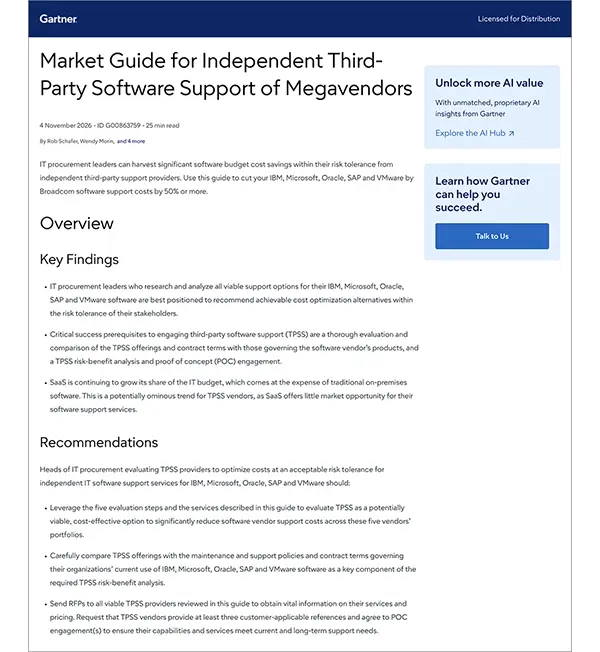
Gartner Market Guide for Independent Third-Party Software Support of Megavendors

